Leonardo Lives!

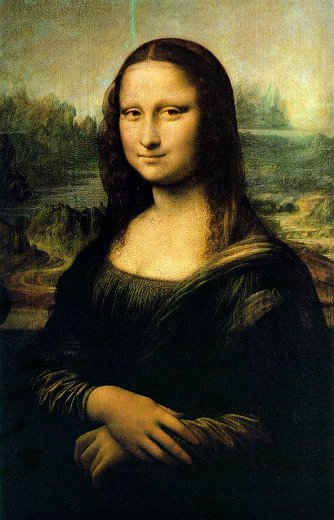
This is just too good not to post. A team of scientists and art historians want to exhume Leonardo da Vinci from his grave in France’s Loire Valley so they can reconstruct his skull and see if maybe the Mona Lisa is a self-portrait. From the London Times:

A team from Italy’s National Committee for Cultural Heritage, a leading association of scientists and art historians, has asked to open the tomb in which the Renaissance painter and polymath is believed to lie at Amboise castle, in the Loire valley, where he died in 1519, aged 67.

Giorgio Gruppioni, an anthropologist, said the project could throw new light on Leonardo’s most famous work. “If we manage to find his skull, we could rebuild Leonardo’s face and compare it with the Mona Lisa,” he said.

The identity of the Mona Lisa has been debated for centuries, with speculation ranging from Leonardo’s mother to Lisa Gherardini, the wife of a Florentine merchant.

Some scholars have suggested that Leonardo’s presumed homosexuality and love of riddles led him to paint himself as a woman.

Recreating Leonardo’s face could test the theory of Lillian Schwartz, an American expert who drew on computer studies to highlight apparent similarities between the features of the Mona Lisa and those of a self-portrait by the artist.

Talks about the exhumation with French cultural officials and the owners of the chateau have resulted in an agreement in principle, according to the Italian team, and the project could receive formal permission this summer.

(Thanks, Kate!)

Galileo: Rescuing the Relics of a Secular Saint

Pity poor Galieo. And not just because his scientific beliefs ran afoul of the Church, because he was tried and condemned for heresy, or because he died while under house arrest. No, pity him because for centuries schoolchildren have been snickering at his right hand. Since 1737, Galileo has been giving us all the finger.

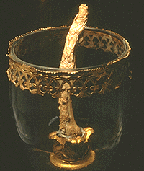
The gesture may seem apt. But it wasn’t his choice: he didn’t go to his grave with one wizened middle digit pointed skyward in an everlasting curse at the universe. Someone arranged it that way, severing his key digit during an exhumation and preserving it an urn, where it has been flipping off tourists at Florence’s Institute and Museum for the History of Science since 1927 (and at other sites before that).

Recently, the Institute announced that two more of Galileo’s severed fingers have been found in a jar, along with a tooth. The revelation means that all the Galileo parts known to have been separated from his corpse are in the hands of the Italian authorities. But how, you ask, did they come to be severed in the first place? Read on.

Galileo died in Florence in 1632. His will called for him to be buried in the magnificent basilica of Santa Croce, where his ancestors rested alongside other eminent Florentines like Michelangelo. But no sooner were plans for his tomb underway than word got back to the Pope, who put the kibosh on them. Not surprisingly, His Eminence decided that honoring a man the Inquisition had found “vehemently suspect of heresy” would be setting a bad example.

Instead, Galileo’s coffin was stuffed inside a tiny chamber beneath Santa Croce’s bell tower, far from the huge marble monuments of the other prominent local citizens. He lay there in an unconsecrated grave for over a hundred years.

In 1737, after years of pleading by Galileo’s devoted student Viviani, the political climate changed. The Church decided that reburying Galileo would be a good thing for Florence, then suffering from a decline in power as the years of the Medici family ended. At last local officials were allowed to move Galileo to a sumptuous new tomb opposite Michelangelo.

Unfortunately, during the exhumation three of the assembled men — Antonio Cocchi, Anton Franceso Gori, and Vincenzio Capponi — decided to take some souvenirs. Here’s how John Joseph Fahie describes it in his 1903 book Galileo, His Life and Work:

During the work of exhumation and identification Canon Gio. Vin. Capponi, President of the Sacra Accademia Fiorentina, took an opportunity of removing with a knife the thumb and forefinger of Galileo’s right hand! Because, as he said to Targioni-Tozzetti, they held the pen with which so many fine things were written; but… Targioni-Tozzetti tapped the skull, and said he would rather have some of the brains which conceived the grand thoughts.

Soon after, Anton. Francesco Gori, Professor of Ancient History in the University of Florence, removed the index finger of the left hand, which, at his death, passed to Canon Angelo Bandini. At his death in 1803, it came into the custody of the Laurenzian Library (of which Bandini had been Keeper), and in 1841 it was transferred to its present place in the Tribuna di Galileo in Florence. …

At the same time, yet another idolater, Dr Antonio Cocchi, Professor of Natural Philosophy and Anatomy, took away the fifth lumbarvertebra, which, after passing through many hands, came into the possession of Dr Thiene. In 1823, he presented it to the University of Padua, where it is now preserved in the museum attached to the physical science laboratory.

Fahie’s text describes the thumb and forefinger as lost, and these are the relics the Institute says have just been re-discovered. There’s no record of a tooth extraction, although the official record does state that at this point the corpse didn’t have many teeth anyway.

What would motivate dignified men of science to spirit away bits of a rotting carcass? It’s hard to say exactly, but they were coming from an era fascinated by the relics of saints. The bodies of saints weren’t seen as inviolable, but as material to be harvested for supernatural power and prestige. Galileo’s admirers probably didn’t think his bones would bring miracles, but they have been influenced by the idea of carcass as trophy and talisman.

Source: Galluzzi, Paolo. “The sepulchers of Galileo“. The Cambridge Companion to Galileo. Ed. Peter Machamer. Cambridge University Press, 1998.

Houdini Alive and Well on the Internet!

Looking for something fun to do on Halloween? Why not help out the good folks at the Houdini Museum in Pennsylvania, and hold a séance attempting to contact the world’s most famous (and very dead) magician.

The museum’s website has put out an internet plea:“We are asking everyone to attempt to contact Harry Houdini sometime during Halloween for the 24 hours of October 31st and email us with any results and lack of results. No kooks please, this is a serious Halloween test and tribute.”

As random as this seems, there’s a tradition of holding Houdini séances. Before Houdini died on October 31st, 1926, he had a long-standing pact with his wife to try to come back and contact her. Justin Nobel tells the story over at Digital Dying:

The séance tradition was begun by Houdini’s widow, Bess. Before Houdini died the couple had agreed upon a code he would whisper in her ear should he ever return to her after death. Bess spent nine Halloweens waiting for Houdini, a ritual that grew increasingly flamboyant. A decade after his death the séance was held on the roof of Hollywood’s Knickerbocker Hotel. An hour passed and nothing happened. The celebrity guests rose to leave when all the sudden a crack of thunder split the air and a torrent of rain fell from the heavens. Could it be the great Houdini, some surely thought. …

Bess asked Walter B. Gibson, creator of the fictional character, “The Shadow”, which he had written more than 300 books about, to carry on the séance tradition. Gibson held the séance at the Magic Towne House, a well-known New York City magic spot. Gibson asked Dorothy Dietrich, a famous escapist and the first woman ever to catch a bullet in her teeth, to take over the séances after he died. Dietrich brought the tradition to the Houdini museum.

Halloween Houdini events have been held in other places. For 68 years, both magicians and the non-magical journeyed to his grave at New York City’s Machpelah Cemetery for a ceremony whose climax involved breaking a wooden wand and chanting: “The curtain has at last been rung down.”

For the full story, check out Justin’s article.

A New Funeral for Poe

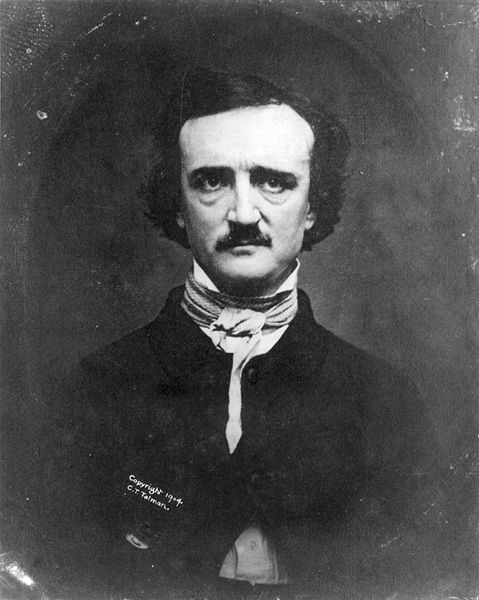
Not many people get a funeral do-over. Edgar Allen Poe, master of the macabre, died October 7th, 1849 under mysterious circumstances. His first funeral was so terrible that on the 200th anniversary of his birth, fans decided to give it another try.

Poe was buried the day after he died in a three-minute ceremony attended by less than ten people. The weather that day was so unusually frigid that the reverend didn’t even bother with a eulogy. A passer-by later reported that the ceremony “was so cold and unchristianlike as to provoke on my part a sense of anger difficult to suppress.” To make matters worse, Poe didn’t even have a proper tombstone until 1875. (A cousin did order one in 1860, but it was destroyed when a freight train ran off the tracks and into the sculptor’s yard.)

Poe’s fortunes have improved considerably since then, but fans continue to resent the way he was treated after death. This year, he finally got the funeral he deserves. 

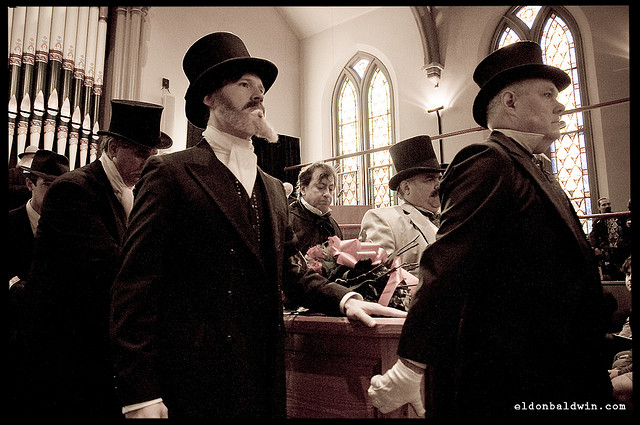
Jeff Jerome, curator of the Poe House & Museum, hired a special effects artist to create a scary-looking Poe corpse (see below), which lay in state for 12 hours at the Poe house in west Baltimore. All photos below are by Baltimore-based photographer Eldon Baldwin.

Poe's "corpse". Photo by Eldon Baldwin, some rights reserved.

Saturday night, fans and friends held an all-night vigil at Poe’s grave in the Westminster Burying Ground. Sunday was the main event, with a horse-drawn carriage taking the faux Poe from the Poe House to the gravesite, where a splendid funeral was held.

Not that I was there — I wish. Fortunately, the Wall Street Journal has a video of the event highlights here and NPR has a rundown here. Actor John Astin (aka Gomez Addams) was the master of ceremonies, and actors playing characters from Poe’s life delivered eulogies. The ceremony was sold out in advance, with 700 people, many in historically-appropriate garb, attending.

Poe's second funeral. Photo by Eldon Baldwin, some rights reserved

It’s amazing that 200 years after a man’s birth, people still feel so attached they will create a mock corpse to give it a final farewell. I’m not sure whether this is a testament to Poe’s magnetism, the endurance of his works, or the dedication of the people at the Poe house and other fans. Many other writers deserve similar celebrations — how about a bunch of patriots getting together today for Thomas Paine, huh?

Hitler’s Head

New post over at The Faster Times about Hitler’s skull. Seems new research proves a skull fragment (at left) long thought to be Hitler’s is actually female:

The History Channel got curious about the skull fragment, which belongs to the Russian State Archive in Moscow and displays a prominent bullet hole smack-dab in the middle. While the Russian authorities have long said the skull fragment belonged to Hitler, and came from the ditch outside his bunker where his body was dumped, the History Channel decided to use some good ol’ fashioned American technology to examine their claims.

While it’s pure morbid speculation (my specialty), the discovery raises the possibility that it was not actually Hitler’s body cremated by the KGB in 1970.

Just in time for Yom Kippur, Daily Intel enumerated the possibilities raised by this discovery, “in descending order of plausibility”. Last on the list: Hitler escaped and is still walking around somewhere. Keep your eyes peeled for a 120-year-old German man, because he’s probably Hitler!

William Blake’s grave: Lost and found

I love visiting the Morgan Library and Museum: Its small size allows for an intimacy that is impossible in the caverns of the Met or the MoMA. I even love the elevator, which is made of glass and slips soundlessly from floor to floor.

In January 2009, the Morgan showed William Blake’s World: “A New Heaven Is Begun,” an exhibition devoted to poet/painter/engraver William Blake. Blake first caught my eye as a teenager: I loved the gentle tones of his watercolors, and his fantastic beasts. The exhibit puts many of the Blake pieces owned by the Morgan on display for the first time in twenty years. These range from small, delicate engravings to lively color prints destined for the covers of Visions of the Daughters of Albion (in part a defense of sexual freedom) or America: A Prophecy (Blake was a big fan of our rebellious little colony).

Like so many geniuses, Blake was under-appreciated in his own lifetime, publishing only a single book conventionally and earning most of his bread as an engraver. Sadly, he died in poverty, and most of the obituaries focused on his eccentricities rather than his brilliant output. Blake was an iconoclast, a freethinker, and generally written off as totally insane. Nevertheless, in the years since then his reputation has vastly improved, with the help of some devoted biographers. Unfortunately, London, Blake’s only home, hasn’t treated his remains very well. In a city of monuments, Blake has no public memorial, and even the site of his grave was lost for 40 years.

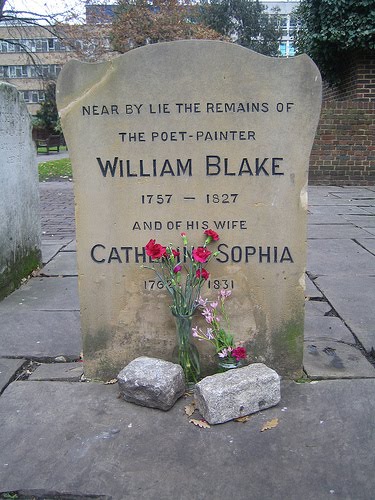
According to a book published around the time of Blake’s death in 1827, “Blake died in his sixty ninth year, in the back room of the first floor of No. 3 Fountain Court, Strand, and was buried in Bunhill Fields, on the 17th of August.” He was buried in an unmarked grave. In 1927, on the centenary of Blake’s death, one of his biographers finally erected a memorial stone over his grave. Unfortunately, the wording for the stone was a little confusing. The stone, which can still be seen today, reads:

“NEAR BY LIE THE REMAINS OF
THE POET PAINTER
WILLIAM BLAKE
1757-1827
AND OF HIS WIFE
CATHERINE SOPHIA 1762-1831”

The use of the words “near by” refers to the fact that while Blake’s grave was directly beneath the stone, the grave of his wife was about 70 meters away. However, many people erroneously believe the wording refers to the fact that Blake’s grave site is lost. In fact, the wording may have helped make that the case.

In 1965, Bunhill Fields began a beautification project, and added a new lawn where several gravestones had been. Blake’s gravestone was moved, but his body was not. Somehow, the records of the location of his grave were lost. Thus his tombstone, standing at an angle against Daniel Defoe’s, became literally true: William Blake was no longer underneath the stone, but somewhere “nearby.”

So the situation remained until 2005, when a London couple, Luis and Carol Garrido, came to pay their respects. Like so many before them, during their visit to Bunhill Fields the Garridos were befuddled by the imprecise wording on Blake’s tombstone. “Nearby lies William Blake?” they wondered. Then came a strange experience. Wandering around the cemetery, the Garridos suddenly became aware of a beautiful fragrance that seemed to fill the air in a particular spot. They walked in a circle, hoping to find a flowering tree or shrub, but found nothing that could be responsible for the fragrance. According to the couple, they “happened to be aware of similar accounts of beautiful fragrances manifesting unexpectedly by the graves of saints of the past.” In fact, Blake is considered a Gnostic saint in Aleister Crowly’s cosmology, and is thought to be the reincarnation of an archangel by Sahaja Yogis. According to Sahaja literature that appears on the web, the Garridos are Sahaja Yogis themselves. That may help explain their determination to find William Blake’s grave.

On a second visit to the cemetery, the Garridos happened to run into the cemetery’s keeper. When they asked if anyone knew where Blake’s grave actually was, the keeper told them that an elderly man who had been responsible for moving the gravestones in the 1960s claimed Blake had been buried not far from the current site of his gravestone, near a Plane tree. The site the keeper was describing was exactly the same as the place where the Garridos had smelled the fragrance. Sensing their enthusiasm, the keeper offered to show them cemetery plans that might elucidate the mystery. However, those documents proved inconclusive, and sent the Garridos on a sleuthing quest deep into the city archives.

Eventually, they were able to discover that all the graves at Bunhill Fields were laid down with north/south and east/west co-ordinates. By plotting the co-ordinates of known graves, the Garridos were eventually able to find Blake’s originally gravesite, as well as those of other members of his family. They’ve detailed their entire quest, and their proof, on their website and in a detailed 106-page book available at the site (which provided much of the information for the post).

A proposal for a new memorial to William Blake has been approved in general, and plans are currently underway. I like the Blake Society’s proposed design, which includes a new headstone as well as one of Blake’s poems carved in a pathway towards his grave: “Hear the voice of the Bard! Who present, past, and future sees; Whose ears have heard/The Holy Word/That walked among the ancient trees.”

Eva Perón’s Restless Corpse

On Friday I went to a lecture about the afterlife of Eva Perón, the former first lady of Argentina, held at the wonderful Observatory space near the Gowanus Canal. Observatory is really just a back room inside Proteus Gowanus, an art space/gallery/office for Cabinet magazine, but their programming makes for a great evening — assuming that staring at slides of anatomical models or damaged corpses is your idea of a good time. (Clearly, it’s mine.) Plus, once you’re drunk on facts and cheap wine, you can wander out to the Morbid Anatomy library and admire all of Joanna’s books and artifacts, like the set of real teeth she has displayed in velvet.

The lecture, presented by Margaret Schwartz, showed that Evita is a great example of how corpses can become contested objects, fought over by loved ones, devotees, and authorities who want to control the way the memory of the deceased is preserved and displayed. The situation is all the more difficult because of the troubled space corpses occupy between the animate and inanimate (even the most atheist among us get really weird around corpses).

Here’s Evita’s afterlife, in brief; I’m relying on my (admittedly fallible) memory of Schwartz’s talk, as well as the indispensable After the Funeral:

After she died of cancer in 1952 at the age of 33, Eva was meticulously embalmed by Dr. Pedro Ara. Ara was a Spanish embalmer who was among the best of his time; he preferred to call himself a practitioner of the “art of death,” and believed in his work so much that he carried the perfectly preserved head of a peasant as a kind of portfolio.

At first, Ara embalmed Evita only long enough for a public viewing, which stretched from a few days to a few weeks as the crowds kept pouring in to weep over their fallen idol. Eventually Ara protested that he needed to get back to work on the body, to prepare it for the grand monument her husband Juan Perón had planned. It was to be larger than the Statue of Liberty.

The second embalming, designed to last forever, took two years and cost over $100,000 dollars. The corpse was immersed in numerous baths of chemicals, and coated in several layers of plastic. The effect was so surreal that later viewers were convinced the body was actually a statue. However, Juan Perón was overthrown before the monument got much past the construction of a hole in the ground, which was later converted into a swimming pool.

When the new Argentine regime discovered Eva’s corpse, they had to cut off a finger and analyze it to make sure the object was really human. Assured it was, they had no idea what to do with the thing: they couldn’t bury it, because the grave would become a pilgrimage site for Perónists the junta wanted to suppress, and they couldn’t destroy it, out of religious considerations. Instead the body disappeared, moved from site to site by the junta, and guarded by a cast of characters that included an army major who shot his wife while the corpse was in their apartment, and a group of soldiers who accidentally bayoneted themselves while driving the corpse in a van.

(Strangely, someone in the Perón camp always knew where Evita’s body was. Whherever she went, flowers and candles would mysteriously appear overnight.)

Eventually, Evita was buried in Milan under the name of an Italian citizen who had recently died in Argentina. That worked for a while, but by 1970 things had gotten so bad in Argentina that those in power wanted Perón back. Perón had certain conditions, however, including the return of his wife’s body.

At around the same time, a former president, Pedro Eugenio Aramburu, was kidnapped and executed by guerrillas, who refused to return his body until Evita’s corpse was returned to “the people”. Aramburu was among the few who knew where Evita’s body was, and had left a sealed letter detailing her secret gravesite in Italy. Lawyers produced the letter, and Evita was exhumed and delivered to Perón. (Aramburu’s body was also returned to his family.)

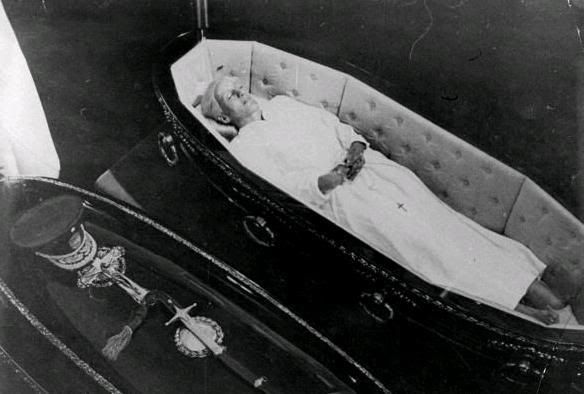
Aside from a broken nose, damaged feet, and a few gashes on her face, Evita was actually in pretty good shape. She was kept at Perón’s villa for a while, even sitting in the dinner room while Perón and his new wife ate their meals. According to After the Funeral, when Perón returned to Argentina to resume power, he left Evita behind, and it was only when the same guerillas re-kidnapped Aramburu’s body that Evita’s body was finally returned to the country. Today Evita lies in the glamorous Recoleta cemetery, right next to all the aristocrats she railed against.

At least Eva has been able to rest peace since then. Juan, who died in 1974, wasn’t so lucky: thieves stole into his coffin in 1987 and cut of his hands, demanding an $8m ransom. None was forthcoming, and so the kidnappers destroyed them.

(Both the Peróns lying in state; Juan in a closed coffin, Evita displayed.)