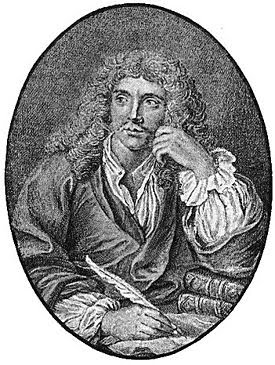
Where’s Moliére? The Mystery of Père Lachaise

Your final address matters most of all. Not the one where you breathe your last, but the one where your bones rest, where your name is engraved on stone. Of course, the irony is that you’ll no longer be there to care, but the terror of that thought makes the location feel all the more crucial. People who sell plots in cemeteries – the scholar Frederick Brown calls them “metaphysical realtors” – are aware of this anxiety, and often seek to exploit it.

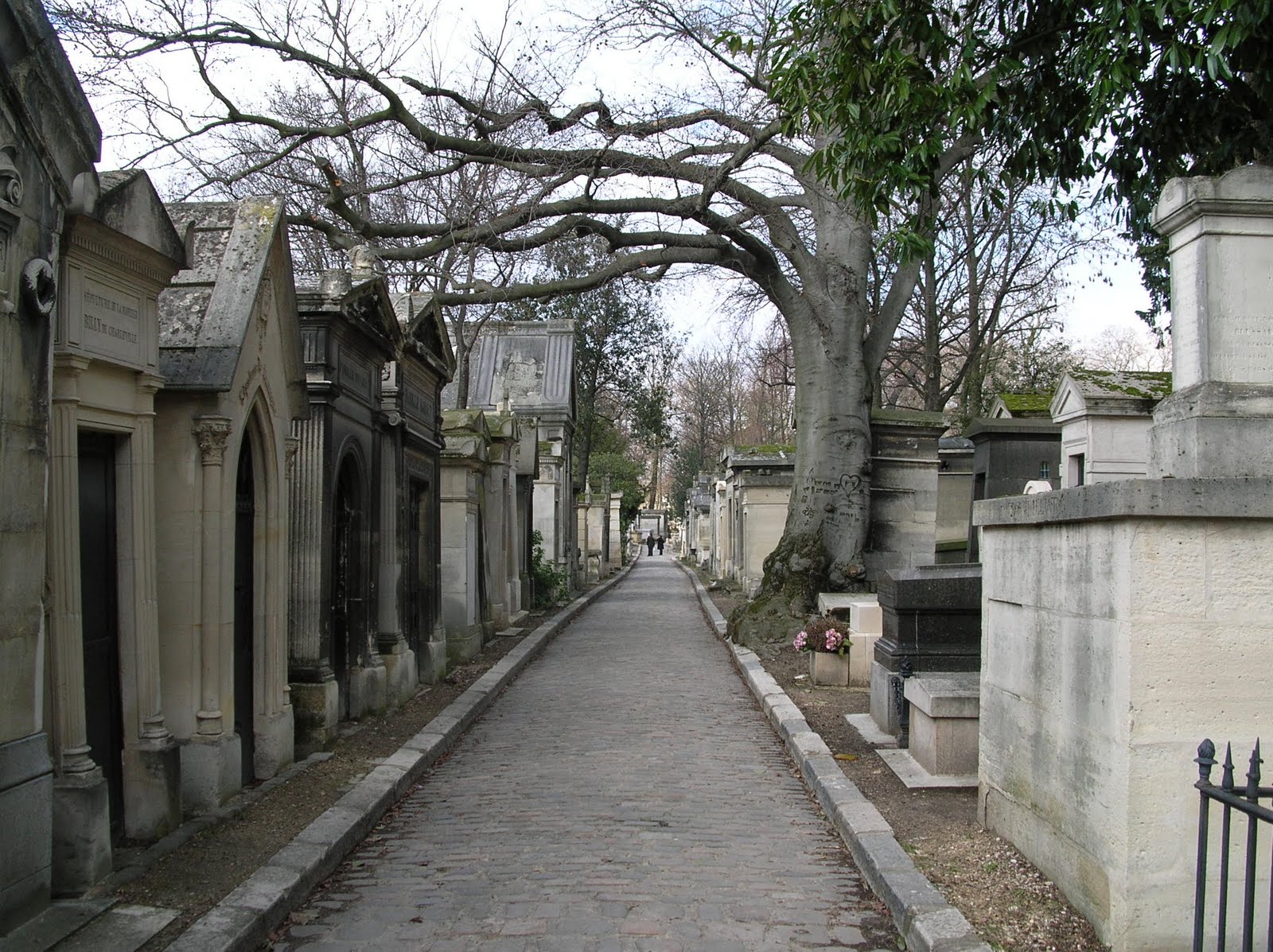
Lately I’ve been reading Brown’s 1973 book, Père Lachaise: Elysium as Real Estate. Père Lachaise, of course, is a sprawling village of the dead in Paris’s 20th arrondissement, home to some of the most famous graves in the world – Jim Morrison, Sarah Bernhardt, Oscar Wilde. Wikipedia says it’s the most-visited cemetery in the world, which is easy to believe. When I visited in February 2010, men half-crazed with cold sold tourist maps outside the entrance (despite the free ones inside) to a steady stream of young art students, couples, and tourists from around the world. I hear that in the spring the place is even more crowded, with both tourists and hundreds of resident cats.

Moliére and the cats of Père Lachaise

For the purpose of this blog, Moliére (1622-1673) is my favorite resident of Pére Lachaise. A famed actor and playwright in his day, he had the singularly ironic fate of  going into his death throes while on stage playing the part of an ill man. He’d written the part himself, in a play of called The Unfortunate Invalid. When he fell ill, the audience had no idea Moliére was actually suffering, and thought his twitches were part of the act. He died, of a lung hemorrhage, about an hour after stepping offstage.

In the bad old days, actors were denied a Christian burial. Fortunately, Moliére’s resourceful widow pulled some strings, and got permission for a night burial in the cemetery of St. Joseph. Details of the precise burial location are sketchy: some say he was buried in a consecrated grave “at the foot of the cross,” others that he ended up in a corner of the graveyard set aside for suicides. Sources are even more divided about what happened in the years that followed: some say he was moved inside the church, others that his body stayed out in the yard.

What we know for certain is in 1792, the revolutionary government decided to name a section of town after Moliere, and went in search of his bones. By that time, no knew for certain where he lay. That didn’t seem to bother the commissioners in charge of his exhumation, who dug in what seemed to be promising spot and labeled the resulting skeleton “Moliere.” Afterward, the bones went to a museum, where they lay for about 18 years, until the man behind Pére Lachaise needed a corpse to be part of the founder’s circle.

Like PR people today, the promoter behind Pére Lachaise, Prefect of the Seine Nicolas Frochot, knew that the presence of celebrities would enhance the desirability of his product. He had a job on his hands convincing Parisians to bury their departed in the eastern suburb where Pére Lachaise lay. They were used to burying their dead in city churchyards, and the idea of a far-flung cemetery seemed a little weird. Because Moliere was so beloved, reburying him in Pére Lachaise seemed like an ideal way to convince the French bourgeoisie that the cemetery was the “in” place to spend eternity. Of course, Frochot had no idea the bones may well have belonged to a pauper or suicide, but he may not have cared. In Père Lachaise: Elysium as Real Estate, Brown says,

“…judging from their haste, one may presume that they cared no more whether these were the real bits of Moliére and La Fontaine than did the Church whether its saints’ relics were historically true. Myths suffice when any bones will do, and any bones, in turn, will serve a myth–in this case a myth still current in France, which has it that her writers, forming a national treasure, mystically belong to her bourgeoisie, however dull and ill-read.”

The move paid off. Today, many of the tourists who pass Moliere’s grave probably don’t know who he is. They’re on their way to throw flowers at Jim Morrison, or plant a lipstick kiss on Oscar Wilde’s grave. But if it weren’t for the bones of the fake Moliere, they might not be there at all, and the Parisian tourist industry would definitely suffer.

Moliére and the cats of Père Lachaise
MeKissingWildesGrave
Moliére and the cats of Père Lachaise

William Blake’s grave: Lost and found

I love visiting the Morgan Library and Museum: Its small size allows for an intimacy that is impossible in the caverns of the Met or the MoMA. I even love the elevator, which is made of glass and slips soundlessly from floor to floor.

In January 2009, the Morgan showed William Blake’s World: “A New Heaven Is Begun,” an exhibition devoted to poet/painter/engraver William Blake. Blake first caught my eye as a teenager: I loved the gentle tones of his watercolors, and his fantastic beasts. The exhibit puts many of the Blake pieces owned by the Morgan on display for the first time in twenty years. These range from small, delicate engravings to lively color prints destined for the covers of Visions of the Daughters of Albion (in part a defense of sexual freedom) or America: A Prophecy (Blake was a big fan of our rebellious little colony).

Like so many geniuses, Blake was under-appreciated in his own lifetime, publishing only a single book conventionally and earning most of his bread as an engraver. Sadly, he died in poverty, and most of the obituaries focused on his eccentricities rather than his brilliant output. Blake was an iconoclast, a freethinker, and generally written off as totally insane. Nevertheless, in the years since then his reputation has vastly improved, with the help of some devoted biographers. Unfortunately, London, Blake’s only home, hasn’t treated his remains very well. In a city of monuments, Blake has no public memorial, and even the site of his grave was lost for 40 years.

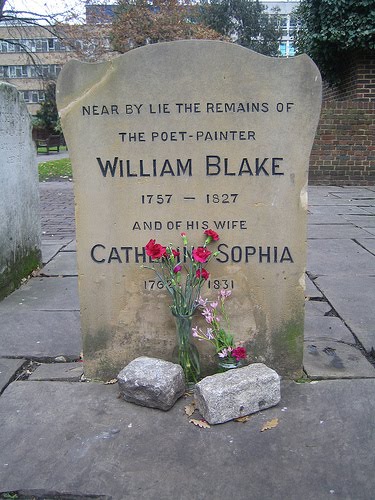
According to a book published around the time of Blake’s death in 1827, “Blake died in his sixty ninth year, in the back room of the first floor of No. 3 Fountain Court, Strand, and was buried in Bunhill Fields, on the 17th of August.” He was buried in an unmarked grave. In 1927, on the centenary of Blake’s death, one of his biographers finally erected a memorial stone over his grave. Unfortunately, the wording for the stone was a little confusing. The stone, which can still be seen today, reads:

“NEAR BY LIE THE REMAINS OF
THE POET PAINTER
WILLIAM BLAKE
1757-1827
AND OF HIS WIFE
CATHERINE SOPHIA 1762-1831”

The use of the words “near by” refers to the fact that while Blake’s grave was directly beneath the stone, the grave of his wife was about 70 meters away. However, many people erroneously believe the wording refers to the fact that Blake’s grave site is lost. In fact, the wording may have helped make that the case.

In 1965, Bunhill Fields began a beautification project, and added a new lawn where several gravestones had been. Blake’s gravestone was moved, but his body was not. Somehow, the records of the location of his grave were lost. Thus his tombstone, standing at an angle against Daniel Defoe’s, became literally true: William Blake was no longer underneath the stone, but somewhere “nearby.”

So the situation remained until 2005, when a London couple, Luis and Carol Garrido, came to pay their respects. Like so many before them, during their visit to Bunhill Fields the Garridos were befuddled by the imprecise wording on Blake’s tombstone. “Nearby lies William Blake?” they wondered. Then came a strange experience. Wandering around the cemetery, the Garridos suddenly became aware of a beautiful fragrance that seemed to fill the air in a particular spot. They walked in a circle, hoping to find a flowering tree or shrub, but found nothing that could be responsible for the fragrance. According to the couple, they “happened to be aware of similar accounts of beautiful fragrances manifesting unexpectedly by the graves of saints of the past.” In fact, Blake is considered a Gnostic saint in Aleister Crowly’s cosmology, and is thought to be the reincarnation of an archangel by Sahaja Yogis. According to Sahaja literature that appears on the web, the Garridos are Sahaja Yogis themselves. That may help explain their determination to find William Blake’s grave.

On a second visit to the cemetery, the Garridos happened to run into the cemetery’s keeper. When they asked if anyone knew where Blake’s grave actually was, the keeper told them that an elderly man who had been responsible for moving the gravestones in the 1960s claimed Blake had been buried not far from the current site of his gravestone, near a Plane tree. The site the keeper was describing was exactly the same as the place where the Garridos had smelled the fragrance. Sensing their enthusiasm, the keeper offered to show them cemetery plans that might elucidate the mystery. However, those documents proved inconclusive, and sent the Garridos on a sleuthing quest deep into the city archives.

Eventually, they were able to discover that all the graves at Bunhill Fields were laid down with north/south and east/west co-ordinates. By plotting the co-ordinates of known graves, the Garridos were eventually able to find Blake’s originally gravesite, as well as those of other members of his family. They’ve detailed their entire quest, and their proof, on their website and in a detailed 106-page book available at the site (which provided much of the information for the post).

A proposal for a new memorial to William Blake has been approved in general, and plans are currently underway. I like the Blake Society’s proposed design, which includes a new headstone as well as one of Blake’s poems carved in a pathway towards his grave: “Hear the voice of the Bard! Who present, past, and future sees; Whose ears have heard/The Holy Word/That walked among the ancient trees.”